





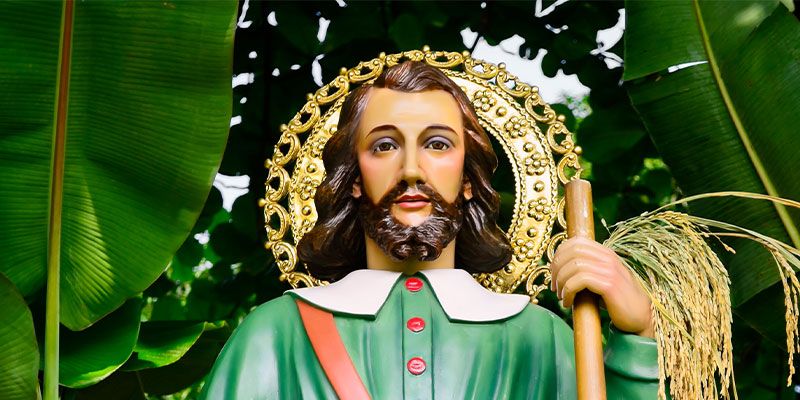
San Isidro is the patron saint of Madrid, of villages with an agricultural tradition, of other villages and towns in the Americas and, of course, of all farmers, winegrowers and agricultural engineers.
The reason he is the patron saint of Madrid lies in his history and the fact that he was a native of Madrid. He is the subject of stories and legends concerning miracles. His ability to find water easily even during periods of drought, his knowledge of the land and a host of other miracles brought him great renown, which continued to grow 300 years after his death.
Saint Isidore is the patron saint of Madrid, of villages with an agricultural tradition, of other villages and towns in the Americas and, of course, of all farmers, winegrowers and agricultural engineers.
The reason he is the patron saint of Madrid is due to his history and the fact that he was a native of Madrid. Stories and legends relating to miracles are associated with him. His ability to find water easily even during periods of drought, his knowledge of the land and a host of other miracles brought him great fame, which continued to grow 300 years after his death.
Who was Saint Isidore?
Saint Isidore the Farmer was born in the year 1080, on what is now Calle de Las Aguas, in what is today the La Latina neighbourhood. He married María Toribia, who would also be canonised and known as María de la Cabeza. It is highly likely that he was a Mozarab, a farmer in his own right and in the service of a lord. Saint Isidore is thought to have been in the service of Juan de Vargas. This is why he is known today by the nickname ‘Labrador’.
He is credited with more than four hundred miracles, including that of the pot containing an endless supply of food, known as the ‘Olla de San Isidro’, which fed thousands of the city’s poor, and that of causing a spring to gush forth (upon which his chapel was built), which supplied the whole of Madrid during a great drought.
Other miracles and legends
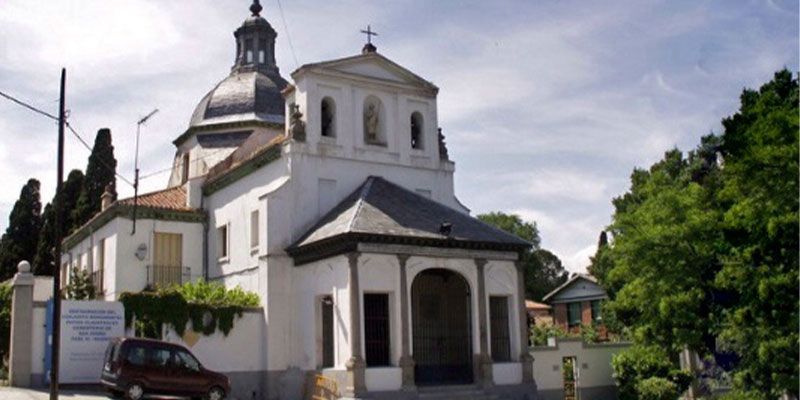
His fame grew over time, particularly after his death. He was credited with healings, such as those of Charles I and his son Philip II, who, upon drinking from his spring, were cured of the fevers from which they were suffering. As a result, Empress Isabella, in gratitude, had a chapel built to house the fountain. He also miraculously cured King Philip III of a terrible illness, which led to his intercession for Philip III’s canonisation.
One of his most famous posthumous miracles was that of guiding (alongside other saints) the Castilian troops to victory at Las Navas de Tolosa against the Almohad army. For this reason, King Alfonso VIII had a chapel built in his honour in the church of San Andrés.
Forty years later, his remains were exhumed, revealing that his body had remained incorrupt; he was therefore transferred inside the church and the process for his canonisation began.
Why is it celebrated on 15 May?
15 May is the date on which the body of Saint Isidore was transferred to the Church of San Andrés and some of his miracles were recognised. It also coincides with the date on which it was decided to beatify him and on which his feast day was decreed.
Since then, every 15 May, the water that he caused to gush forth is blessed, and it is customary to go and drink the ‘miraculous’ water that flows from the spring next to the chapel of San Isidro. People enjoy the traditional ‘rosquillas tontas’ and ‘rosquillas listas’ as a snack and round off the day by taking part in the open-air festival where the chotis is danced.
This year marks the fourth centenary of his canonisation and, for this reason, the first Holy Year of Saint Isidore has been declared, running from 15 May this year to 15 May 2023. Consequently, in addition to the usual festival programme, a host of activities have been organised which will run until 15 May 2023.
Here at SLEEP’N, we encourage you to make the most of them and to visit the San Isidro Museum, a small, free museum that you’re sure to enjoy.