





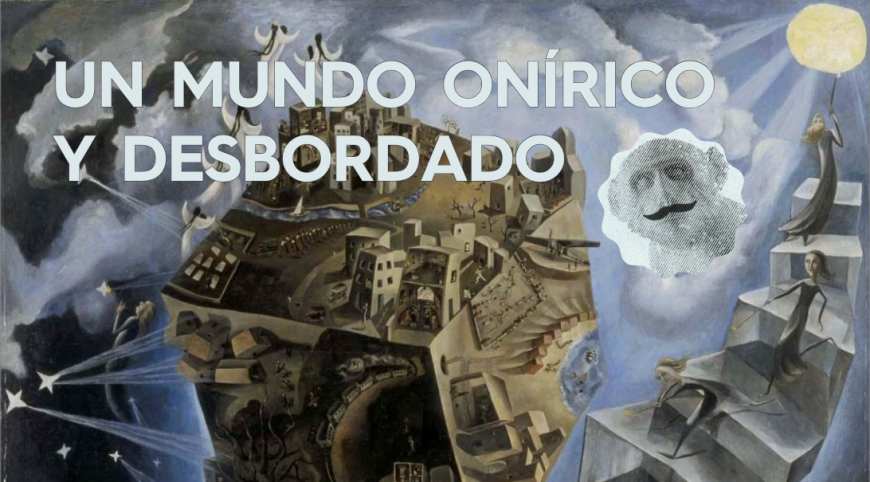
After visiting the Reina Sofía from SLEEP'N Atocha, the author discovers in *Un mundo de Ángeles Santos* a poetic and powerful contemporary allegory about the fragility and hope of the planet.
I leave SLEEP’N Atocha, that oasis in the heart of Madrid, with one thing in mind: to explore the Paseo del Arte as if it were my first time. Just 130 metres away, I turn right and within minutes I find myself at the Reina Sofía Museum. This institution, housed in the former General Hospital of Madrid, bears the architectural signature of José de Hermosilla, Francisco Sabatini and Jean Nouvel, and is home to some of the most unsettling and visionary works of the 20th century.
I step into the glass-walled lift, suspended between heaven and earth, and make my way into the galleries of the Sabatini building. And then I come upon it. That painting which seems to hang not from a wall, but from the sky itself. *Un mundo* (1929), by Ángeles Santos, is imposing not only because of its scale, but also because of the vertigo it induces.
This large canvas — in fact, two joined together — sprang from the imagination of a young woman barely 18 years old, who had only just begun to take her first painting lessons in Valladolid. Yet what unfolds here is not a youthful exercise: it is an almost mystical vision.
However, like so many other visionary works, *Un mundo* spent years in obscurity. The Reina Sofía Museum acquired it in 1997, but it was not until recently that it re-emerged from the storerooms into the light, becoming part of the renewed discourse on the historical avant-garde. Today it stands alongside names such as Picasso, Maruja Mallo and Óscar Domínguez, in a fair and necessary reinterpretation of 20th-century Spanish art.
The painting depicts a planet that appears round and floating, yet transforms into a cubic world, eschewing astronomical order to embrace a more intimate and literary logic. On its surface, women read, sleep or march in procession, surrounded by factories, impossible staircases and trees of unusual colours. Some steal fire from the sun to light the stars, whilst others rock their children to the rhythm of invisible music, born of the fusion of wind and strings. Everything burns in a contained silence, as if the world were gently consuming itself from within.
There is a poetic intensity in this scene that evokes magical realism, a movement that had not yet been named when Ángeles painted it. And this is no coincidence: the painting’s inspiration stems from verses by Juan Ramón Jiménez, whose influence can be felt in every corner of the work.
‘Un mundo’ is neither a utopia nor a dystopia: it is both. It is an indictment and a beacon of hope. Ángeles Santos, in the full vigour of her youth, shows us a planet that seems to beat from within, from a consciousness that observes and points out without judging. The circular composition evokes the divine, the eternal, yet the figures inhabiting it feel trapped, like puppets in a drama greater than themselves.
Just as Grosz did with his *Metropolis*, Santos portrays an existential crisis. But whilst he cries out from the midst of urban chaos and the brutality of war, she murmurs from within a dream, from a world that has not yet been completely destroyed, but which is crying out for a new beginning.
Today, as the planet once again faces vital dilemmas — the environmental crisis, overexploitation, digital alienation — “A World” becomes a contemporary allegory. How can we rebuild a world that is more humane, more harmonious, more our own?
I leave the museum, unable to stop looking up, as if I were expecting to see that cubic land suspended above the sky of Atocha. Back at SLEEP’N, amidst walls that celebrate sustainability and thoughtful design, Ángeles’s question still echoes: What kind of world do we inhabit, and which one do we want to build?
-by Connaisseur Mr. Paco