





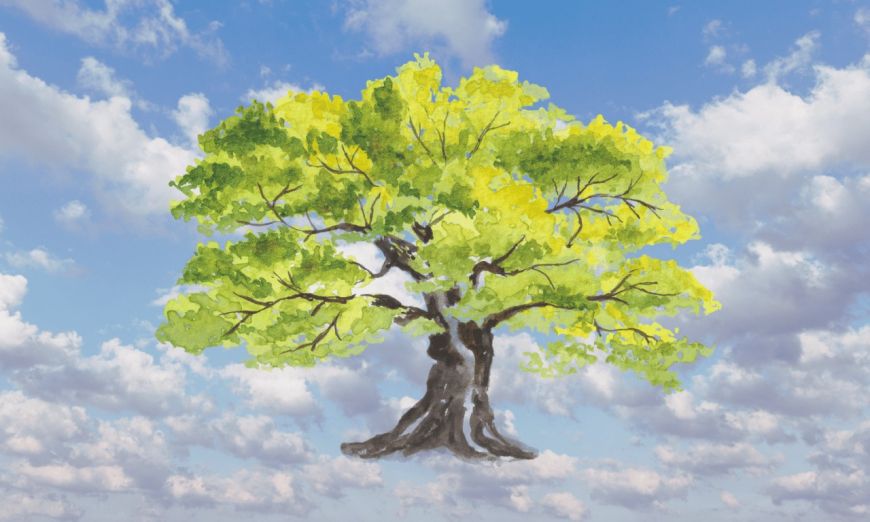
Trees and forests are part of our ancestral heritage and bear witness to our presence in the world. Deforestation jeopardises our relationship with these natural giants, which, to a large extent, shape the identity of these territories
Children’s stories in which leaves come to life, marvellous forests where anything can happen, and a mythology – such as Greek mythology – that reveres the olive tree and tells the story of Daphne’s transformation into a laurel tree, amongst other myths. The Cosmic Tree, the Tree of Life or the Tree of Knowledge. Since time immemorial, trees have symbolised the cycle of existence and the power of nature. This is hardly surprising, given that many centuries ago the continents were covered by a vast green blanket that we humans inhabited and revered. Mythology, religions, literature and cinema are full of references to these natural giants, providers of oxygen, shade, coolness and beauty.
The bond between people and trees connects us to the countryside, to a slower pace of life, to the possibility of contemplation and a return to our wild essence. Beyond their role as providers of fruit, timber and paper, walking amongst them means allowing ourselves to be enveloped by their colours, textures, the sound of the wind through their branches, the rustling of their leaves on the ground and the scurrying of the animals that inhabit them. In short, it means immersing ourselves fully in life. This is also the starting point for the popular practice of forest bathing.
The naturalist Ignacio Abella Mina says that safeguarding trees means defending the Earth, innocence, culture, beauty and everything that has neither a voice nor weapons to defend itself: ‘We are protecting our world and those yet to come. We defend ourselves against the threat posed by those who, with premeditation, under cover of darkness and with malice aforethought, continually speculate on, sell and destroy what has taken so long to build. Defending the tree is defending ourselves’.
Ensuring the conservation of trees also means safeguarding the identity and memory of the land
Ensuring the conservation of trees also means safeguarding the identity and memory of the region: that holm oak under which groups of girls used to gather in their childhood, the garden with the apple tree that inspired Newton’s theories, the village’s main park guarded by those plane trees… We forge countless memories around trees, because they have been part of some of the most defining moments in many people’s lives.
In the book *The Scent of the Forests* (Siruela, 2024) by Dominique Roques, the author journeys through the world’s forests to explore the complex bond between humans and trees. ‘Fundamentally mobile, people compensate for the brevity of their lives through movement,’ he states. ‘They have never ceased to put their intelligence at the service of a kind of voracity, a need to dominate, to serve their fellow human beings and nature. The tree is immobile, enduring and silent. It occupies space vertically, from the depths of the earth where it sinks its roots to the point where it seems to touch the sky as it rises a hundred metres to unfurl new leaves to the sun and the wind. The movement of its life is internal, as it labours to push the sap from its roots to the tips of its branches. It does not speak, yet we continue to uncover its codes of communication and mutual aid with its neighbours through its roots and leaves. It harbours and nourishes all manner of life forms—birds, rodents, insects and fungi—which disperse its seeds and ensure its continuity by helping its offspring to germinate. The profound contrast between these two forms of life led to an inevitable clash, symbolised by one man: the woodcutter.’
Over the last thirteen years, deforestation has claimed more than 40 million hectares worldwide
It is estimated that over the last thirteen years, deforestation has claimed more than 40 million hectares worldwide, leading to the disappearance of forests, jungles and natural ecosystems and, in many cases, causing irreversible damage to nature. This loss also entails a rupture with an ancestral and natural relationship. That is why, today, some of the main actors working to ensure the conservation of forests are indigenous peoples—communities which, although they occupy one-tenth of the world’s land area, preserve 80 per cent of the planet’s biodiversity. They have no intention of allowing their livelihood and the Earth’s oxygen supply to be destroyed. Or for it to be destroyed by others.
In her book *Errata Naturae* (2021), the writer Mary Oliver also extolled the virtues of these natural giants: ‘And I search deep within the forest, beyond the firebreaks and the cycle path, amongst the black oaks and the tall pines, on quiet, blue afternoons, when the sand is still frozen and the snow falls slowly and haphazardly, and the whole world smells like water in an iron cup’. To seek and find, or to lose oneself amongst the wonders of the woodland world, is always a way of life – perhaps more than that, and certainly a little better.
Article from Ethic magazine. Read article