





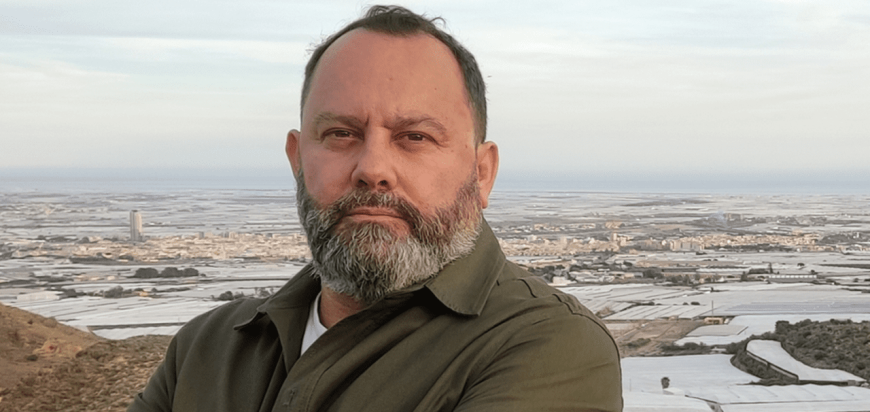
Miguel Ángel Criado (Almería, 1968), a journalist specialising in climate change, the environment, biology and anthropology, talks to us about his latest essay
How will rising temperatures affect a country like Spain in the medium and long term?
It is already changing it. Above all, there is already a significant change in terms of flora and fauna, but also in tourism, the economy and city life. The geographical distribution of animal and plant species is changing. The climate is shifting from the more Mediterranean areas – from Castellón to Granada – towards the north-west, and this directly affects species, causing them to migrate. It is no longer straightforward to use the simplistic terms ‘Mediterranean’, ‘Atlantic’ and ‘continental’ climates that were previously employed. Agriculture is one of the sectors most affected, particularly cereal farming: there will be a shortage of water, not only due to a lack of rainfall, but also because of the extremely low ambient humidity – the amount of water vapour in the atmosphere, which is linked not so much to rainfall as to temperature, and which has not been this low for eight hundred years. This directly affects, for example, trees and plants across Europe, and exacerbates the water problem.
However, it would seem that people in rural areas – those most directly affected by climate change – are the most reluctant to embrace the 2030 Agenda, and the least receptive to the proposals aimed at tackling the emergency we are facing…
It is the human condition – the attitude towards climate change. The measures being implemented, and those planned to mitigate the effects of climate change and adapt to the new conditions, are not always well received in more traditional sectors, such as the countryside. Furthermore, there has not been a significant educational effort to explain clearly what the situation is and what it will be if we do nothing. Meanwhile, some politicians are capitalising on this discontent and engaging in demagoguery. We must explain that there will be no water in the future; this is not an assumption, it is a certainty. And we must bear in mind that every major change brings enormous benefits, but also creates losers – and in this case, the losers are in the agricultural sector. Yet they stand to lose even more if they fail to adapt to the changes. This is explained by cognitive dissonance. Let me give you another example: in areas where Nazi extermination camps were located – which one would think should have served as a warning – over the last twenty years the percentage of votes for neo-Nazi parties has been higher than in nearby towns and villages where there were no extermination camps. That is cognitive dissonance: when you believe your view of the world is the only valid one, and you fail to take into account the facts or the experts’ conclusions.
‘There hasn’t been much educational work to properly explain what the situation is and what it will be like if we do nothing’
But your book, whilst acknowledging the gravity of the situation, offers some hope.
The fact is, there is a great deal that can be done. Fernando Martínez de Toda, a professor at the University of La Rioja, told me that grapes used to be harvested around All Saints’ Day. Later, around the Feast of Our Lady of the Pillar. And now they are being harvested at the end of August. This means bringing the harvest forward by almost two months; for some crops, such as fruit trees, the consequences are minor, but for grapes they are serious. For some years now, vineyards have been facing north, and in some cases even being moved up into mountainous areas. Sometimes it is a matter of adopting an adaptive approach, whilst recognising that the situation is dire.
And what about tourism?
Tourism accounts for 14.5 per cent of Spain’s GDP; more than three million people make their living from tourism. It will be the sector hardest hit by the heat. Who wants to go to Egypt, Tunisia or Algeria in the summer? Something similar will happen in southern Spain; people will stop coming to the most popular tourist areas. A year or two ago, I saw a photograph in a newspaper showing a beach full of British tourists. What was striking about the image, taken in June, was that it was in the south of England. Reports are already being produced which suggest that tourism is declining in the south. We must therefore focus on deseasonalising tourism, aiming to ensure there is tourism all year round, as is the case in the Canary Islands, and this would resolve three of the problems caused by tourism: it would enable higher-quality work in the sector by generating year-round employment rather than just seasonal jobs; it would allow local authority public services – which are always overwhelmed in summer and underused in winter – to operate more normally; and it would ease the pressure on the natural environment. Most visits to protected ecosystems and areas tend to take place in summer – the Tablas de Daimiel, for example. If we spread tourism out over the year, the impact would be much less.
‘Yes, there may well be a tourism boom in northern Spain, but we must learn from the mistakes made in the Levante region and the south’
In other words, before long, tourists will prefer Spain’s northern coast to the south.
Yes, they’re increasingly staying in the north, in the traditional destinations of the Belle Époque, from La Coruña to San Sebastián. I read an article in *El Diario Vasco* in which they lamented that, in 2023, there were fewer overnight stays in San Sebastián than in 1923, which gives us an idea of what tourism was like back then. Yes, there may well be a tourism boom in northern Spain, but we must learn from the mistakes made in the Levante region and the south.
Is tourism incompatible with sustainability?
Not necessarily. The problem is not tourism itself but the intensity of tourism; it is a mistake to associate tourism with unsustainability. What cannot happen is for so many people to climb Everest at the same time. Of course, there are examples of tourism-related crimes – one need only think of El Algarrobico – but if the intensity of tourism is reduced, the problem subsides.
How does the heat affect mental health?
There are films, novels and studies that have examined its impact on racial conflicts. Remember *Fury*, that film in which a man stuck in a traffic jam, sweltering in the heat, explodes in a fit of rage. Heat affects our temperament; it puts us in a bad mood – we’ve all experienced this. There are already studies on how heat affects gender-based violence. It has a much greater impact than it might seem, of course.
‘The hotter it gets, the lower consumption is across all sectors, except one: the pharmaceutical sector’
Does the planet’s sustainability depend on a drastic fall in the world’s population, in consumption, or on both factors?
As for a smaller population, I’m not sure. Nor do I consider it credible that consumption will decline, either in developed or less developed countries. Consumption is, in a way, a right to happiness. What we need to do is focus on changing consumption patterns and improving the quality of that consumption. The obvious example is fossil fuels. Granted, solutions sometimes give rise to other side issues, such as the environmental impact throughout the life cycle or the impact of batteries, but these are being addressed. The number of electric cars is rising; in other words, one of the biggest sources of emissions – the internal combustion engine – will disappear within ten years. 93.8 per cent of new vehicles in Norway are electric. We must remember that Norway is Western Europe’s leading oil producer. We also need to take action on what we eat and how we eat it. There are things we can do – many of them. We need to learn to eat differently.
Is reducing meat consumption really that important?
Yes, particularly because of how it’s consumed, how it’s produced, and how certain agricultural products – such as manure or rice itself, which is a massive source of methane – are used.
It’s interesting that heat is inversely proportional to consumption.
Yes, reports confirm that the higher the temperatures – the heat – the lower consumption is across all sectors (restaurants, clothing, leisure) except one: the pharmaceutical sector. At night, when the temperature gives us some respite, consumption rises. In other words, heatwaves leave us parched.
Article from Ethic magazine. Read the article