





Buildings have a very significant impact on the environment. Buildings account for between 30 per cent and 40 per cent of global energy demand (these figures vary from country to country) and are responsible for almost half of CO₂ emissions into the atmosphere.
Buildings do not only cause pollution through the energy consumed whilst we live in them; they also do so when we construct them, through the manufacture of materials and the production of waste.
The manufacture of steel and concrete (two of the most common materials in construction) requires fossil fuels such as oil or natural gas.
WHAT IF WE BUILT BUILDINGS THAT COULD ACT LIKE TREES, PURIFYING THE AIR?
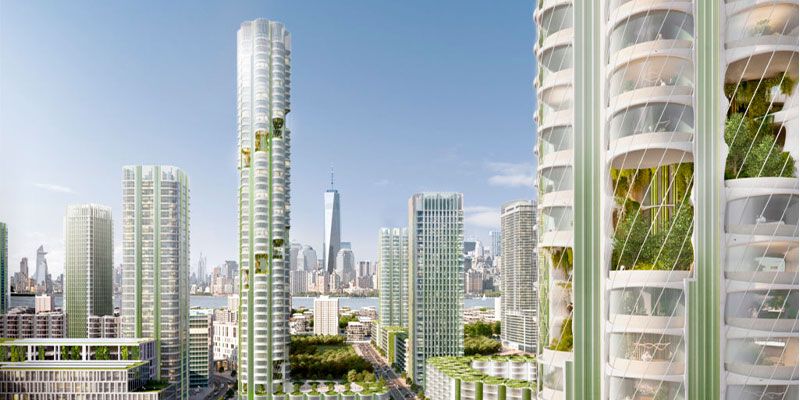
Based on this idea and inspired by natural ecosystems, the architectural practice Skidmore, Owings & Merrill (SOM), comprising designers, engineers and architects, has devised a prototype building that absorbs pollution whilst promoting the circular economy: the Urban Sequoia.
SOM presented its project at the 2021 United Nations Climate Change Conference (COP26).
WHAT DOES THE URBAN SEQUOIA DESIGN INVOLVE?
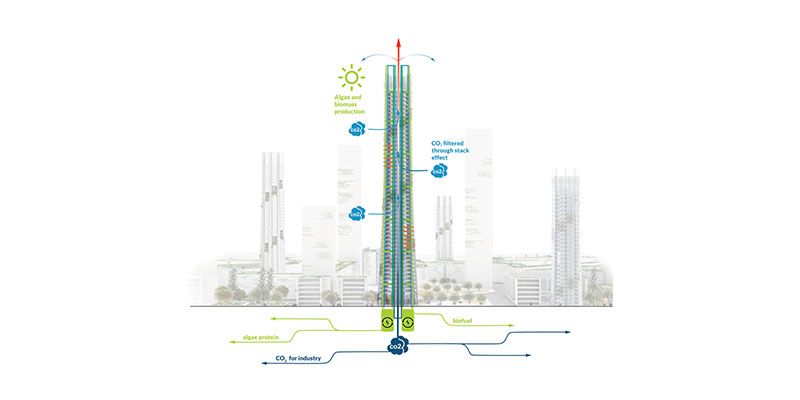
SOM’s prototype is a sustainable high-rise building capable of capturing up to 1,000 tonnes of carbon per year, equivalent to 48,500 trees.
This design incorporates sustainable methods and natural materials, such as hemp, timber, biocement and bio-bricks, which reduce the carbon footprint of construction by 50 per cent compared to concrete and steel. And ensuring that, 60 years after its construction, it absorbs up to 400 per cent more carbon than it might have emitted during the building process.
Incorporating biomass and algae into the façade would provide a source of biofuel capable of powering heating systems and cars.
The research team emphasises that these features can be replicated in any type of building, including parks and other green spaces.
CHANGING THE COURSE OF CLIMATE CHANGE
What is novel about this idea is that buildings would go from being part of the problem to part of the solution, moving beyond net zero and helping to heal the planet.
If buildings like the Urban Sequoias were constructed in every city around the world, it would be possible to remove up to 1,000 million tonnes of carbon per year.
We would be building a more sustainable future and could change the planet’s future by transforming the course of climate change.
All we can do now is wait to see whether this model for cities is feasible, whilst we continue to promote sustainable and energy-efficient construction.